

What are Community Development Financial Institutions and How Can Investors Support Their Impact?
By Donovan Ervin
Catalyzing Impact with Community Development Financial Institutions
Community Development Financial Institutions (CDFIs) are specialized US financial institutions and lenders that provide capital to underserved communities and businesses that may not qualify for traditional financing. For impact investors, CDFIs can offer a scalable way to generate social impact while supporting economic development, affordable housing, healthcare, education and small business growth.
Why do high-impact businesses struggle to access capital?
High-impact businesses need capital that matches their structure, timeline, and reality.
Consider this: A woman- and Native-owned farming company in the Pacific Northwest, we’ll call it Project Seed Bank, aims to feed tribal neighbors, steward the land, and promote economic development. Project Seed Bank employs regenerative, biodynamic Native farming practices to grow Native crops – such as tribal peppers, tomatoes, herbs, and flowers – for Native communities, while also offering a line of packaged tribal sauces, teas, and snacks. The founder-owner, like any business leader, needs financing to make strategic purchases for business stability and growth.
However, conventional finance doesn’t meet the needs of this type of business. Because of historical discrimination and ongoing disinvestment, many traditional lenders don’t operate in rural and Native communities.1 Even if Project Seed Bank were to qualify for a traditional loan, the lender would charge a high interest rate and require collateralization of personal assets, on account of higher perceived risks.
Moreover, repayment of the loan would likely begin immediately, despite the seasonality and prolonged harvesting and sales cycle of a food production business. Traditional capital, therefore, can lead to a relentless cycle of debt that can destroy the business and deepen mistrust of the financial industry, all to the detriment of the community.
What is Catalytic Capital and how does it address financing gaps?
Catalytic capital refers to investments that intentionally accept lower risk-adjusted financial returns, higher risk, or longer time horizons in order to achieve greater social or environmental impact.
Fortunately, catalytic capital is a type of impact investment that intentionally aims to fill these financing gaps. Acknowledging the limitations of conventional finance, catalytic investors accept lower risk-adjusted financial returns in exchange for greater social or environmental impact.
In the case of Project Seed Bank, a Native-led Community Development Financial Institution (CDFI) provides low-interest, patient, and culturally responsive loans that meet the distinctive needs of Native-led food businesses. One of the loan products offered, for example, charges a significantly lower interest rate and allows borrowers to make interest-only payments for up to five years before beginning principal repayment. The CDFI also provides technical assistance to help borrowers enhance their business operations. In this financing model, producers are given a fair chance to employ indigenous, ecologically sound production methods, provide food for their communities, and grow a prosperous enterprise.
More broadly, this approach to catalytic investing can propel transformative societal outcomes. Without the pressure to quickly deliver profit-maximizing returns to investors, capital providers like CDFIs are empowered to offer financial tools that better address the nuanced needs of the intended beneficiaries.
Moreover, when investors accept lower financial returns, catalytic providers can, in turn, charge lower rates to end borrowers. This helps to keep capital circulating in target communities, which can accelerate economic development and enhance overall impact. In fact, recent research from the Miller Center for Global Impact estimates that intentional catalytic investment can multiply impact by 6x – 40x.2
What are CDFIs and why are they important in impact investing?
CDFIs are catalytic by design. For context, Community Development Financial Institutions (CDFIs) are US Treasury-certified financial institutions that provide loans, banking services and investment capital to underserved communities.
Nationwide, in rural and urban areas and Red and Blue states, there are over 1,400 designated CDFI entities listed as community development banks, credit unions, loan funds, and venture capital funds. Some have a national footprint, while others are regional or local. CDFIs provide a wide range of products, including FDIC-covered personal checking accounts and Certificates of Deposits, individual and small business loans, and larger loans supporting community organizations.
And they operate in high-impact themes and sectors, including affordable housing, education, healthcare, small business lending, energy efficiency, and, as noted above, Native food production. In addition to providing financial capital, many have robust technical assistance programs, financial education training, and policy and research arms.
How does community investing through a CDFI work?
As catalytic intermediaries, CDFIs source capital from external investors and redeploy that capital to community borrowers. Notes programs provide a critical source of capital for community investing. An investor makes a loan to a CDFI, typically at a rate of return lower than an investor could get from comparable investment opportunities. The CDFI then offers high-impact, affordable loans, along with hands-on support, to the end borrower. The revenue from those community loans covers note repayment and some CDFI operations.
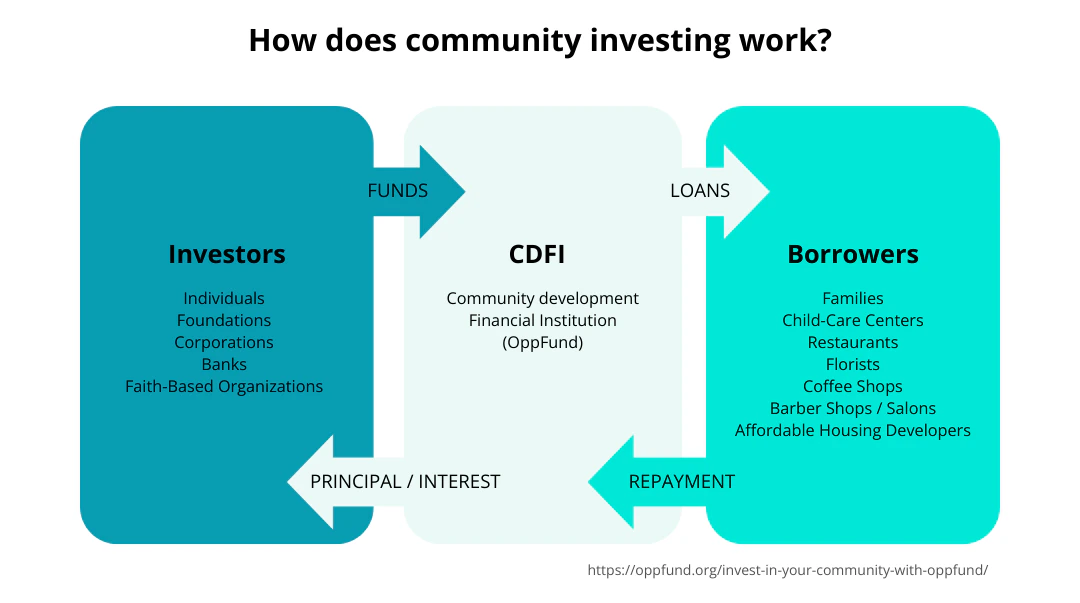
A typical CDFI note investment involves four stages:
- An investor lends capital to a CDFI through a note programme.
- The CDFI deploys capital through affordable community loans.
- Borrowers may also receive technical assistance or other support.
- Revenue from community loans supports note repayment and CDFI operations.
This type of investing is critical for companies like Project Seed Bank, but it comes at a financial cost to investors. The model only works when catalytic investors acknowledge structural barriers and are willing to accept lower financial returns in exchange for deep impact. Even still, most CDFIs employ an integrated capital approach, meaning they use grant funding in addition to interest income to achieve their mission.
Why do investors allocate capital to CDFIs?
Although they don’t address every gap in impact capital markets, CDFIs tend to be core components of catalytic investment portfolios because, as outlined below, they are well equipped to deploy patient, community-centered capital at scale.
- High impact & additionality – Roughly two-thirds of CDFIs cannot fully meet the demand for their products,[1] indicating that CDFIs are filling a significant need that would otherwise go unmet.
- Historical financial performance – Thanks to rigorous underwriting and risk management, CDFIs have had a historical loan loss rate of less than 2%, which is on par with bank loans.[2] This enables confident allocations.
- Well-established, regulated industry – The CDFI Fund, a bipartisan-supported entity within the US Department of Treasury, certifies CDFIs and administers federal grants to CDFIs. This regulatory oversight, in conjunction with industry groups and ratings agencies, promotes transparency.
- Aligned with investor interest – The wide range of sectors and geographies covered by CDFIs offer pathways to more efficiently allocate catalytic capital according to investors’ theories of change.
How does AlTi evaluate and invest in CDFIs?
At AlTi, CDFIs are an important component of our catalytic impact investment platform. We have partnered with several national and regional CDFIs, typically allocating to promissory notes programs. As with all investments on our impact platform, we perform rigorous due diligence, assessing key factors for success, including team, strategy, portfolio performance, and organizational sustainability. Given the intentions of our catalytic program, we hold these groups to the highest standard of impact by closely evaluating criteria such as intentionality, additionality, outcomes, and proximate leadership.
Who might CDFI investing be relevant for?
- Investors seeking measurable community impact;
- Foundations or donor-advised structures exploring mission-aligned capital;
- Institutions with place-based or thematic impact objectives;
- Investors able to accept the relevant liquidity, return, duration and credit characteristics.
What risks and challenges are CDFIs facing today?
Despite their strong impact, performance, and support, CDFIs have recently encountered macro challenges.
In 2025, funding for the CDFI Fund was suspended by executive order and the government shutdown. Bipartisan advocacy enabled the CDFI Fund to resume certifying CDFIs and distributing federal grants as quickly as feasible, demonstrating the industry’s resilience. However, these interruptions have taken a toll on the sector by forcing CDFI leadership to spend more time defensively planning for instability, instead of focusing on deploying capital to communities.
Other exogenous factors threaten CDFIs. For example, if federal government stops enforcing the Community Reinvestment Act (CRA), CDFIs may see less philanthropic and investment capital from larger private financial institutions. Additionally, broader economic volatility could trigger higher default rates among vulnerable borrowers, while simultaneously increasing the need for CDFI financing.
How can investors support the CDFI ecosystem?
At a moment when capital gaps are widening and macro headwinds persist, catalytic investors have a meaningful opportunity to strengthen the CDFI ecosystem in the following ways:
- Invest: support the investment activities of CDFIs by providing them with low-cost capital.
- Give: make a philanthropic grant to a CDFI to support hands-on services and overall operations.
- Advocate: communicate your support for CDFIs to family, friends, colleagues, and policymakers.
Key takeaways
- Community Development Financial Institutions (CDFIs) provide capital to underserved communities that may not be well served by traditional lenders.
- CDFIs are an important channel for catalytic capital because they can offer patient, community-focused financing.
- CDFIs support sectors including affordable housing, healthcare, education, energy efficiency and small businesses.
- Investors can support CDFIs through investments, philanthropic grants and advocacy.
About the Author
