

Written by a human… but for how much longer?
By AlTi Global
“ChatGPT is a highly advanced artificial intelligence language model developed by OpenAI, a leading research organization in the field of AI. This model is trained on a massive amount of text data from the internet, allowing it to generate human-like responses to a wide range of questions and prompts.” This is the definition of ChatGPT straight from the source.1
With over 1 million people signing up in the first two months, – ChatGPT has had a swift and monumental impact and generated heated debate as to its benefits and risks, and as such it is an opportune moment to delve deeper into what the impact this new development in AI technology is having and will have on our lives.2 Two months is not enough time to fully understand the short, let alone long-term impacts of this technology; nevertheless, already we have seen the early signs of future disruption in certain sectors and industries, academia and education as prime examples, as well as continued discourse on whether the benefits of this step forward in generative AI outweigh the risks.
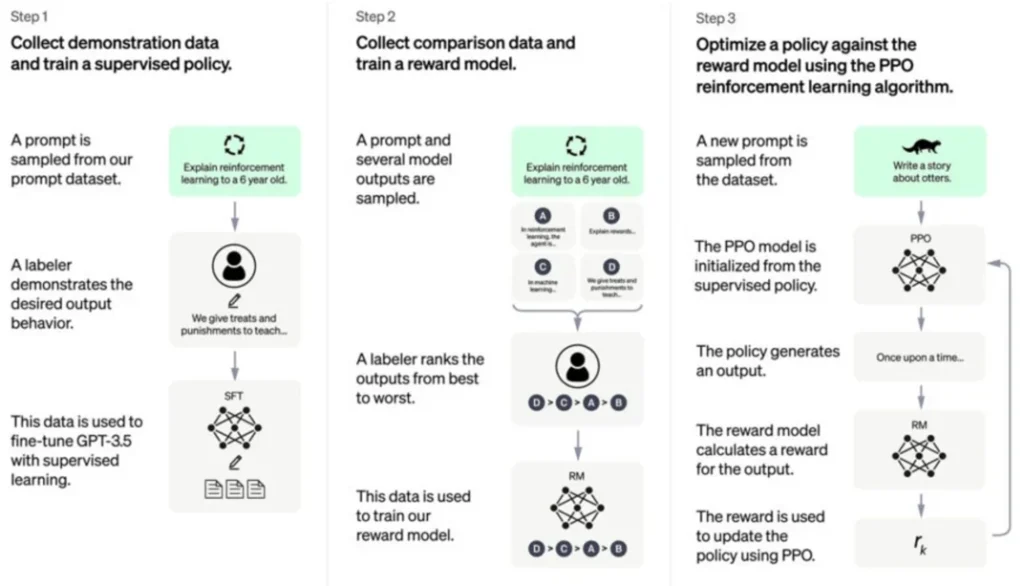
Before we delve further into these, it is important to summarise what has changed with the launch of ChatGPT. After all, chat bots are not new. GPT-3 is the third-generation natural language processing model that uses machine learning to analyse data, and respond to tasks such as answering questions, translating and summarising text. GPT-3’s technology works by using vast data sets from a variety of sources on the internet, as well as books; in total 570 GB of data, and around 300 billion words. As the technology evolves it also continuously learns from mistakes as it goes and, therefore, is constantly improving its accuracy and the power of its offering.3
How does it work?
Source: OpenAI
ChatGPT itself is a chatbot that makes use of this technology, its instantaneous popularity deriving from its ability to create a more conversational and human-like level of output than previous examples.4 The results are staggering and amusing in almost equal measure. It can write songs, books, computer code, pass exams and tell jokes. Albeit there are still notable inaccuracies and biases in the output which we will come on to discuss a little later. San Francisco-based OpenAI’s goal was to develop an AI technology that “benefits all of humanity”. A lofty goal indeed, and while it remains to be seen if that can be achieved, the widespread impact overall is already becoming clear.
For the traditional search engine this is clearly ground-breaking, which likely explains Microsoft’s significant investment of $1bn in OpenAI through 2019 and 2021, followed by a further $10bn multi-year investment announced in 2023.5 It is therefore no surprise that Alphabet is scrambling to play catch up to maintain Google’s dominant position in this space. Outside of the world of big tech, the ripple effect is being felt in other sectors where ChatGPT is already able to swiftly replicate, in just a few seconds, the work that a human would take days or even weeks to accomplish, and with equal if not better results.
In the world of academia, ChatGPT is already presenting a headache. Clear issues have arisen with students’ use of ChatGPT to adapt or even fully create coursework or homework with limited graft. One publication even proclaimed that “The College Essay is Dead” only weeks after ChatGPT was released.6 More recently, the chat bot successfully passed an MBA exam set by Wharton Business School, again demonstrating how in just a short space of time decades of traditional academic and educational practise have begun to be overturned.7
The New York education department has now banned access to ChatGPT on its devices and networks. A spokesperson explained that “while the tool may be able to provide quick and easy answers to questions, it does not build critical-thinking and problem-solving skills, which are essential for academic and lifelong success.”8 This is undoubtedly true, but technologies such as this are not going away and to simply ignore them rather than try and incorporate them into, in this case, the education system is naïve. It is also unrealistic to imagine a student cannot simply access the software on their personal device and achieve the same ends.
Sometimes the best way to capitalise on this kind of disruption to the status quo is to be quick to adapt. For example, in schools and colleges, some teachers have reportedly been using ChatGPT to create quizzes for students, to lesson plans and even to better asses work submitted by their students.9 In a similar vein, BuzzFeed recently announced that it will be using the technology to improve quizzes and other online content.10 Their view potentially that if you can’t beat them, you had better join them.
We have stressed the impact on education and academia, but naturally there are dozens of other industries and sectors that will undergo significant disruption almost immediately, and through the longer term, from the evolution of ChatGPT: journalism, and the concept of authorship in general will be reassessed, legal briefs can be drawn up in minutes, call centres will require no human presence at all, coding as a career path may soon be redundant. For years there has been debate about the extent to which AI will gradually take away the jobs of the college-educated workforce in certain areas, and ChatGPT has accelerated this discussion. We have been here before and as yet no ground-breaking technology has yet left a truly gaping hole in employment, but arguably the ability for ChatGPT to adapt and improvise is a huge leap to replicating human-like output not seen previously.11
There are broader issues here that also need addressing. The internet – i.e., the source of data – is rife with misinformation, fake news and unethical, racist, sexist and often explicit context. Such content is not always easily excluded from the data set of a machine learning system that seeks to constantly trawl the web for more and more content to improve its knowledge base and output. Yes, ChatGPT has filters of sorts, but we are not there yet. Serval early adopters have managed to get ChatGPT to produce some overtly sexist and racist content. One highly publicised example was a professor at Berkely who manged to get it to produce comments stating only white or Asian men could be good scientists.12 It should be acknowledged though, that as quickly as these issues have arisen, they have been addressed and the technology adapted; after all this is a machine that is constantly learning.
An overarching issue that will continue to plague ChatGPT is around more recent (2021 and later) topics since the machine has not had time to ingest enough data on recent events to be fully informed. The system also appears to struggle with the niche and overly complex, again likely through less readily available and smaller data sets. Once again though, these are likely issues that can be ironed out as the technology is further developed.
Disruptive and ground-breaking technologies are always divisive and ChatGPT is no different. The implications, and risks, are clear without even having to scratch the surface, and that is before we consider the many still yet unknown repercussions of this technology. In a recent interview even OpenAI co-founder Sam Altman was unable to avoid highlighting the pitfalls alongside the potential: “I think the best case is so unbelievably good that it’s hard for me to even imagine…The bad case — and I think this is important to say — is, like, lights out for all of us.” 13