

Women’s Health: Addressing Unmet Need, Unlocking Value
By Donovan Ervin
In its most recent Series D financing round in February 2026, Midi Health announced a $100M raise at a valuation of over $1 billion. An online platform providing virtual care for women in perimenopause, menopause, and beyond, Midi has now joined the ranks of more than 25 “unicorns” simultaneously delivering better health outcomes for women and top-tier value creation for investors.1 Against the backdrop of a promising market environment, we see the recent success in women’s health as an enduring investment opportunity that can create both economic and societal value.
Understanding the women’s health gap and opportunity set
Despite representing 50% of the population, women have been overlooked and underserved at every point in the healthcare system – including research and development (R&D), diagnosis, treatment, and benefits. For example, until legislation passed in 1993, US-based clinical researchers weren’t required to include women in trials. Resultant treatments – many of which are still in use today – were designed for men, without accounting for physiological differences between sexes. More recently, only 5% of global R&D funding was directed towards women’s health research in 2020. Women consequently disproportionately contend with misdiagnosed and untreated conditions and spend 25% more of their lives in poor health than men.
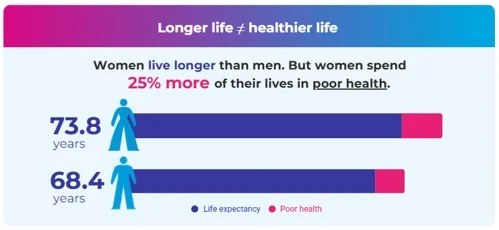
Source: Six uncomfortable truths about women’s health – UNwomen.org
The women’s health category has emerged to fill this gap, providing care, products and services for women of all ages. Historically, the definition of women’s health focused narrowly on reproductive and maternal health and predominantly women’s cancers, such as breast cancer. Now, thanks to continuous advocacy and a changing landscape, the category has expanded to include conditions that impact women uniquely (e.g., menopause, maternal health), differently (e.g., cardiovascular disease, depression), and disproportionately (e.g., lupus, osteoporosis, Alzheimer’s).
Women’s health enterprises are pursuing an array of commercial models. Some companies focus on devices or employee benefits, while others focus on diagnostics or consumer health. Some companies sell directly to consumers, while others sell to insurers or employers.
What makes women’s health a promising financial opportunity?
Beyond the many benefits at an individual level, the women’s health category, aided by favorable market conditions, offers a compelling opportunity for investors seeking competitive financial returns.
- Systemic market failure – Persistent underinvestment has created an opportunity to fulfill unmet demands of a massive, underserved population. The historically overlooked category can often provide investors with access at favorable prices and terms.
- Large, growing total addressable market – The global market for women’s health is conservatively estimated at $420+ billion and, with a 6 – 8% compound annual growth rate, is projected to exceed $600+ billion by 2030.2 A few high-growth subsegments are digital health, diagnostics, therapeutics and oncology, benefits management, and longevity services.
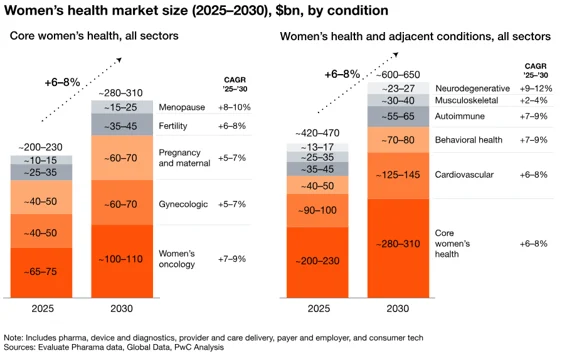
- Technological & scientific innovation – Advances in pharmaceuticals, biotech therapeutics, consumer health technology, and AI-enabled software make sex-specific precision care more accessible, effective, and affordable.
- Shifts in capital supply – Women are acquiring a greater share of wealth and influence in the Great Wealth Transfer. This shift increases the likelihood that investment decisions better reflect the needs and perspectives of women.
- Increased market activity – In the 10-year period ending in 2022, there was a 1,000% increase in women’s health start-ups.3 In 2024 and 2025, record levels of private capital flowed into the segment, enabled by an uptick of specialist fund managers.4 Roughly half of all exits happened in the past 5 years.5
In addition to offering potential financial upside for investors, improving women’s health outcomes can generate far-reaching benefits for society that extend well beyond the individual. When women’s health improves, labor participation and economic productivity are enhanced, and healthcare costs for individuals, households, and public health systems are reduced.6 In fact, the McKinsey Health Institute estimates that improved health for women could increase economic productivity by $1 trillion by 2040.
Associated risks and challenges
Along with the regulatory, development, and technology risks inherent to the broader health sector, women’s health is challenged by its nascency. Roughly 50% of private investments in women’s health-specific companies are at the earliest, riskiest stages, compared to one-third of companies within healthcare more broadly.7 Unfortunately, these start-ups have struggled to attract later-stage growth capital because institutional investors want to see more evidence of M&A and IPO exits that demonstrate the segment’s viability across the full company lifecycle. As such, high-potential, early-stage women’s health companies are at risk of stagnating. However, recent momentum, especially exits led by strategic acquirers, has drawn increased interest from investors at every stage.8
How does AlTi invest in women’s health?
At AlTi, we believe that within a diversified portfolio, women’s health presents a compelling investment theme. We look to work with fund managers well positioned to select and support successful companies. In our diligence, we assess the viability of the investment strategy, along with the team’s track record, industry expertise and relationships, and experience navigating market risks.
Impact Investing
The potential to generate both financial value and societal impact makes women’s health a strong fit for clients interested in impact investing. For such opportunities, we evaluate the commercial criteria listed above, along with the manager’s approach to impact management and measurement. Importantly, we seek managers with an intersectional investment strategy that considers how factors like age, geography, disability, race, and socioeconomic status can influence women’s health outcomes.
Catalytic impact investing
For aligned clients, AlTi aims to support catalytic women’s health investments that deliver lower risk-adjusted financial returns in exchange for greater impact. Community birthing centers, as an example, provide culturally centered, holistic care that can reduce maternal mortality rates, which are disproportionately high in low-wealth and/or rural communities, and communities of color. As a part of our developing women’s health catalytic strategy, we’re looking for partners providing low-cost, patient, flexible capital to these centers and other community-based women’s health organizations.
About the Author
