

The greatest risk to family wealth may not be market volatility
By Jill Shipley & Harmony Abney
Purpose as a Tool for Generational Preparedness
Wealth management firms promote their ability to preserve, protect, and grow wealth. That is an important foundation. But for families managing wealth across generations, financial performance alone does not answer a more fundamental question: what is this wealth to support and make possible?
In our opinion, returns are the “how.” Purpose is the “why.”
As the largest intergenerational wealth transfer in history unfolds, many families are discovering that the greatest threat to long-term wealth preservation may not be market volatility, but generational unpreparedness. Wealth can be transferred through legal structures and financial strategies but sustaining it across generations requires something more: clarity of purpose, engagement, and preparation.
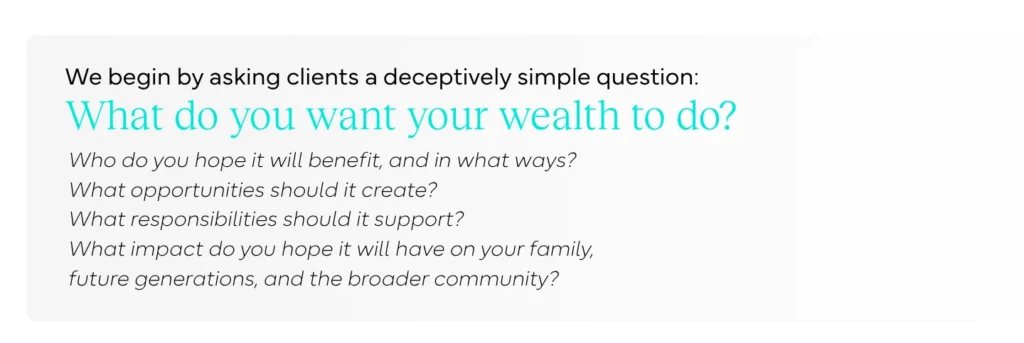
The answers to these questions help families uncover their unique purpose of wealth and create a roadmap for aligning their resources, decisions, and activities with what matters most to them.
Purpose is not static. It evolves as families grow, circumstances change, and new generations develop their own perspectives and aspirations. When families take the time to articulate a shared purpose for their wealth, it provides a common language, helps align priorities across generations, and serves as a north star when difficult decisions or conversations arise.
The Rising-Generation Imperative
In our experience, long-term success, however a family defines it, depends on preparing, engaging, and empowering the rising generation in that process. Research1 has shown us the number one request from rising gen inheritors is to understand the purpose of the money.
We hear many say they do not feel ready for their financial future and are confused about what their parents or previous generations want them to do (or not do) with the money. They want to make their families proud, but the lack of transparency and direction is paralyzing.
At the same time, leading generations frequently express a simple aspiration: they want their wealth to be a positive force in the lives of their children and grandchildren. Yet many struggle with how to achieve that outcome. They worry about creating dependency, diminishing motivation, or unintentionally passing on entitlement rather than opportunity.

The Engagement Gap
Despite good intentions, meaningful engagement of the rising generation remains limited. Many inheritors have only a partial understanding of their family’s wealth, little insight into its intended purpose, and few opportunities to participate in conversations about its future.
The reasons are understandable. This work requires families to confront two deeply uncomfortable topics: money and mortality.
Most wealth holders did not grow up with significant wealth themselves. They worry about how financial privilege may shape their children’s identity, motivation, and sense of purpose. Many fear that too much transparency could diminish ambition or disconnect future generations from the values and work ethic that helped create the wealth in the first place.
Conversations about wealth transfer can be equally challenging. For many family leaders, discussing transitions means contemplating a future in which they are no longer present. After spending decades carrying responsibility for the family, the business, and the wealth, imagining others stepping into that role can be difficult, both practically and emotionally.
On the other side, the rising generation faces its own challenges. Many feel a sense of guilt or shame about having so much more than others that they did nothing to earn. Most have grown up in the shadow of a level of financial success that may feel impossible to replicate. This is why preparation matters. Before wealth can become a positive force in their lives, they need context, clarity, and confidence in the role they can play within the family’s future.
What we hear consistently is that rising generation family members want to be involved. They want insight, agency, and a voice in conversations that will ultimately shape their future. Yet many families delay these discussions for years. If the leading generation lives to 90, their children could be 70 and have spent decades waiting for a voice. Their grandchildren may be in their 30s and 40s, waiting too.
When communication is absent, preparation is absent. Over time, silence creates uncertainty, uncertainty creates disengagement, and disengagement creates risk. What begins as a desire to protect the rising generation can unintentionally leave them unprepared for the opportunities and responsibilities that wealth creates.
At the same time, increasing longevity has added another layer of complexity. Families today often span three or even four living generations, each with their own experiences, priorities, and attitudes toward money. While this creates extraordinary opportunities for connection and shared learning, it can also make alignment more challenging. Purpose can help bridge these differences by creating a shared framework that connects generations while still allowing for individual voices and aspirations.

Preparation Beyond the Balance Sheet
Articulating a purpose for wealth is only the beginning. Its value comes from how it shapes decisions, behaviors, and opportunities across generations, influencing everything from family meetings and governance structures to investment allocation, philanthropy, education, and rising generation engagement.
The most successful families we have experienced do not let inheritance arrive like a meteor from outer space: sudden, unexpected, and without context. They engage the rising generation early, helping them understand why the wealth exists, what opportunities it is intended to create, and what responsibilities accompany it.
Successful wealth transfer is a process rather than an event. For a period of time, multiple generations hold the baton together, creating an opportunity to share knowledge, values, and lessons learned before responsibility fully transitions to the rising generation.
No family hopes its wealth will create conflict, dependency, or division. Most want it to expand opportunity, strengthen relationships, and contribute positively to the lives of future generations. While a shared purpose cannot guarantee those outcomes, it can provide a common language across generations and greater clarity about what the wealth is ultimately intended to accomplish.
The question is not whether wealth will influence future generations. It will. The more important question is whether that influence will be left to chance or guided by purpose.
An earlier version of this article originally appeared in WealthManagement.com on August 12, 2026
- Campden Wealth / AlTi Tiedemann Global The Family Office Operational Excellence Report 2025
About the Authors

Jill Shipley
