

From Vision to Venture: Women Leading the Charge in Entrepreneurship
By Teresa Wells
In honor of Women’s Entrepreneurship Day, we wanted to take a moment to reflect on the value women bring to business, what barriers persist in equal access and empowerment, and share stories from a few founders in our community.
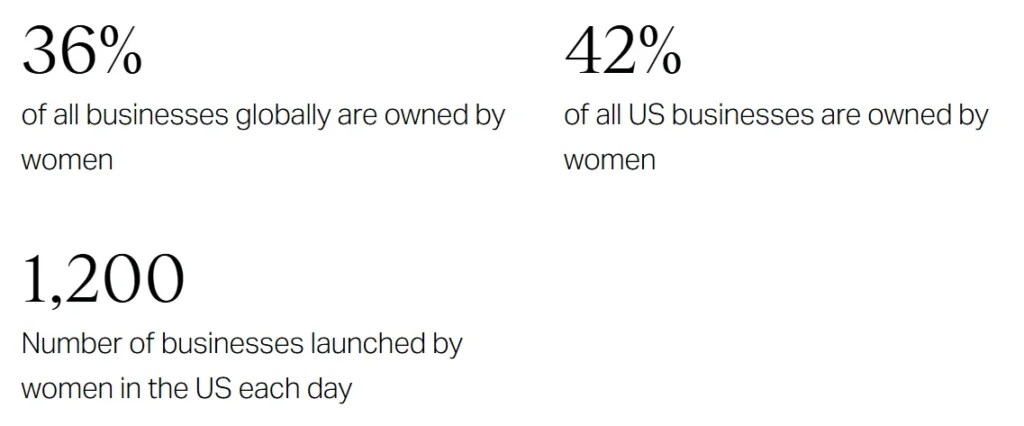
Throughout the world, the face of business is changing…and looking decidedly more feminine. Roughly 36% of all businesses globally are owned by women1 – 42% in the U.S.2 – but that number is increasing rapidly. In the last two years, women started roughly half of all new businesses, up from only 25-30% in the years prior3, and women in the U.S. launch around 1,200 new businesses each day. Despite facing continued challenges, female entrepreneurship is thriving.
In honor of Women’s Entrepreneurship Day, we wanted to take a moment to reflect on the value women bring to business, what barriers persist in equal access and empowerment, and share stories from a few founders in our community. Similar to the broad range of industries in which women owned businesses excel, we’ll recount experiences from successful founders in the AI, clean energy finance, fintech and health / beauty industries as they navigated launching and leading their businesses.
So what drives women to start a business?
According to the most recent Global Entrepreneurship Monitor Report4 there were two distinct drivers for women relative to men: a lack of viable opportunities, and a desire to make a difference in the world. In our interviews, these themes rang true as well. Paula Begoun, founder of global skincare brand Paula’s Choice, actually began her entrepreneurial journey in the publishing business, “because [she] couldn’t get any publishing company to even consider taking [her] books” and was consistently told her books wouldn’t sell because “[she] wasn’t a famous model or celebrity.” Those books – on women’s skin/haircare and cosmetics – went on to become national bestsellers, earned Paula multiple appearances on the Oprah Winfrey Show and eventually led Paula to launch her own skincare line.
Jessica Bailey, co-founder of Nuveen Green Capital (formerly Greenworks Lending, LLC) felt compelled to make the world a better place. After spending years in policy and government, she became frustrated by the pace of decarbonizing our buildings, before launching a specialty finance company to accelerate the transition to clean energy in commercial real estate. Martina Welkhoff was “passionate about community building and interaction but disillusioned by social media platforms” so she created a mobile gaming company, Zealyst, to try to improve human connection. Lastly, Erin Papworth, co-founder of Nav.it, a financial health technology company, launched her business after spending years in behavioral health and seeing the “how much financial stress affected people’s quality of life.” So, these stories resonated with global statistics.
Launching a business is a challenging feat and significant barriers persist for women, particularly in raising capital. Even the government agency created to foster entrepreneurialism, the Small Business Administration, sets an annual goal of only 5%5 of its loans to women-owned business – and actually celebrated that 5.19% of loans were awarded to women in 2019. (Sadly, it fell to only 4.63% in 2022.) More broadly, women globally receive an average loan size of $39,000 versus $44,000 for their male counterparts6, and are 18% more likely to be rejected for a loan than men7. As of 2022, women founded companies received only 2.1% of venture capital investment8. Erin recalls how grueling it was to raise capital from external parties and how time consuming it is to build those fundraising networks. Paula once shared that she started Paula’s Choice on credit cards! It’s hard not to see the bias in this, particularly when presented with the economic value created by women entrepreneurs. According to the World Bank, women owned firms in the U.S. are growing at twice the rate of other firms, create greater job growth and are contributing upwards of $3T to the economy9. But despite clear reasons for investment, stories abound of discriminating language towards female founders. One founder recalled the only feedback she got after nailing a pitch to a group of angel investors was that she wasn’t “bubbly” enough when explaining her technology innovation. Another was asked – after sweating out many months and countless hours building her company – whether she was creating a “lifestyle company” to work at part-time while raising her family. Yet another recalled an investor demanding to control how their investment would be spent, to ensure they weren’t just using it to decorate their offices. (Fortunately, she was able to walk away from that one.)
But capital raising is far from the only, or even the hardest, challenge entrepreneurs face. Martina recalls the difficulty in shifting from her very clear and very strong initial vision for the company. Initially blind to the market signals that were pointing her elsewhere, she found it really hard to “remove emotion from the experience while maintaining the same passion for the vision.” Paula recalls her biggest challenge while running Paula’s Choice was in “perpetually trying to find the best employees to work with.” However, now that she’s recently retired, Paula finds it mentally and emotionally taxing to see other people making decisions about the direction of the company she worked so hard to build. Jessica and Erin both spoke to the challenge of constant pivoting, putting out new fires, and growing with the business over time.
It’s inspiring to hear equal parts humility, humanity and industriousness in these stories. Some degree of imposter syndrome showed up in responses as well. Three of the founders we interviewed recalled a similar feeling….that they thought they were building a great business, but didn’t really understand or dare believe it was great until it was sold. When Paula’s Choice sold to Unilever, in what was then the largest cosmetics company transaction in history10, Paula still didn’t believe it until days later when the check hit her account. Jessica recalls that the first four years she spent grinding, and not fully reflecting on what she was building. But when the company was sold to a strategic buyer, she felt such pride and relief for her team to have landed in a place that offered them meaningful careers, benefits, and wealth creation…all while contributing to the reduction of greenhouse gases.
Each of these entrepreneurs described how being a woman influenced them in many powerful ways – how they built their teams, how they collaborated with their colleagues and the field, how they led. But one quote offers beautiful insight into how being a woman shaped her business success.

Being a woman influenced everything I did in business. The way I interacted with my employees, the decisions I made, how I thought about business always seemed distinctly different from the way I often saw [men] doing it. Rather than being focused solely on the bottom line and coming out of any issue as the winner, I focused on the responsibility to the customer, and in finding a way to achieve resolutions in a compassionate or even joyful process whenever possible.
About the Author
